
 Edit Right Advisors
Model 4B of Evidence Engine. Report it right.
Inclusion Insight Lens
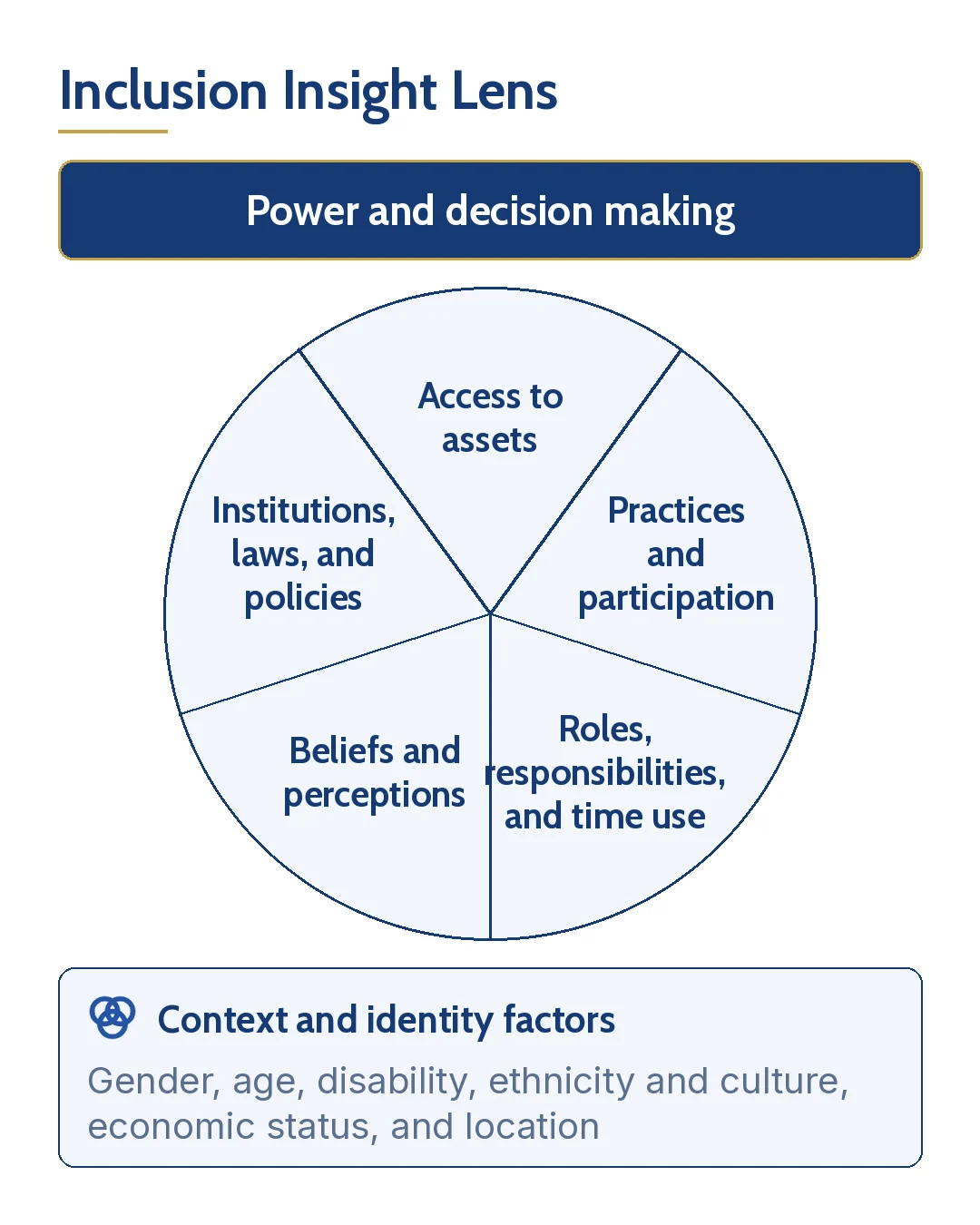
Inclusion Insight Lens is Edit Right Advisors' gender equality, disability, and social inclusion (GEDSI) analysis model. With power and decision making at the top, it analyzes five domains: access to assets; practices and participation; roles, responsibilities, and time use; beliefs and perceptions; and institutions, laws, and policies. Six context and identity factors apply across all five.
What is Inclusion Insight Lens?
Inclusion Insight Lens is Edit Right Advisors’ gender equality, disability, and social inclusion (GEDSI) analysis model. Programs can reach many people and still miss those most often left out. Funders such as DFAT and FCDO expect a GEDSI analysis that shows who benefits, who does not, and why. Left unsolved, the design misses people it should serve and the proposal loses ground on inclusion. Inclusion Insight Lens shows who a program reaches and who it misses, and turns that into practical choices for design, delivery, and reporting.
When should you use Inclusion Insight Lens?
Use it if a funder requires a GEDSI or gender analysis, or you suspect your program misses the people most often left out.
In your words: “The donor requires a GEDSI analysis, and we have never done one.”
How does Inclusion Insight Lens work?
Power and decision making sits above the lens and shapes every domain. The five domains form the lens, and the context and identity factors apply across all of them. We hear directly and safely from excluded groups, with consent processes suited to the people involved.
- Power and decision making: Who decides, at home, in the community, and in institutions
- Access to assets: Who has access to and control over resources, services, and opportunities
- Practices and participation: Who takes part in activities and decisions, and how
- Roles, responsibilities, and time use: Who does what work, and how time is divided
- Beliefs and perceptions: The norms and beliefs that shape what people can do
- Institutions, laws, and policies: The formal and informal rules that include or exclude people
Context and identity factors: gender, age, disability, ethnicity and culture, economic status, and location.
What you get
- Outputs: findings broken down by context and identity factors, with practical recommendations for design, delivery, and reporting.
- Result: programs reach the people most often left out, and reports show honestly who is included.
Delivered through SS-04 Research and Reporting.
What we need from you
- The people, groups, and context the work concerns
- Data that can be broken down by identity factors
- Safe, direct access to the voices of excluded groups
Who it is for
- NGOs and community-based and similar organizations: see who is reached and who is missed.
- Funders: receive GEDSI analysis that meets their requirements.
- Government: see how laws, policies, and institutions include or exclude people.
- Researchers: get a structured GEDSI analysis across five domains and six identity factors.
Illustrative example
Illustrative example only. This is a generic scenario, not a client result.
A livelihoods program reaches many households, yet a funder asks for a GEDSI analysis. Inclusion Insight Lens looks at power and decision making, then each of the five domains. Data broken down by identity factors, and safe conversations with excluded groups, might show that women with disabilities attend less often because of travel time. The recommendations set out practical changes to design, delivery, and reporting.
Recognized practice behind Inclusion Insight Lens
- Gender analysis domains. All five domains (access to assets; practices and participation; roles, responsibilities, and time use; beliefs and perceptions; and institutions, laws, and policies) are adapted from the USAID ADS 205 gender analysis domains, via Jhpiego. Power and decision making runs across all five.
- GEDSI analysis. The model follows the GEDSI analysis approach in DFAT and FCDO guidance, including DFAT’s GEDSI analysis good practice note.
- Identity factors and disaggregation. Disability data can use the Washington Group Short Set on Functioning where appropriate.
Inclusion Insight Lens is adapted from the USAID ADS 205 gender analysis domains, via Jhpiego. Sources: Jhpiego Gender Analysis Framework; DFAT GEDSI analysis good practice note (archived copy); Washington Group Short Set on Functioning.
Edit Right models are our own structured adaptations of established practice. Naming a benchmark, author, or institution does not imply accreditation, membership, or endorsement.
How Inclusion Insight Lens connects
4A Assessment Arc
Explore the model4C Proof Pyramid
Explore the model1A Readiness Radar
Explore the modelParent framework: Evidence Engine
Back to the frameworkFrequently asked questions
What is a GEDSI analysis, and is it only about gender?
GEDSI stands for gender equality, disability, and social inclusion. The analysis covers gender, age, disability, ethnicity and culture, economic status, and location, and how these factors combine to shape who benefits from a program.
Which frameworks does the lens draw on?
All five domains are adapted from the USAID ADS 205 gender analysis domains, via Jhpiego. It follows the GEDSI analysis approach in DFAT and FCDO guidance.
How do you hear from excluded groups safely?
We hear directly and safely from excluded groups, with consent processes suited to the people involved.
Key terms
- Equity and inclusion analysis: Analysis of who benefits from a program, who does not, and why.
- GEDSI: Gender equality, disability, and social inclusion.
- Context and identity factors: Gender, age, disability, ethnicity and culture, economic status, and location.
- Washington Group Short Set: A standard set of questions for disability data.
Not sure Inclusion Insight Lens is the right place to start? Book a free call: editright.io/call We will listen, tell you honestly whether it fits, and suggest a first step.
Email hello@editright.io or call +1 314 998 0221.
Newsletter
Get the Latest Updates
Funding opportunities, proposal and grant writing tips, and practical insights straight to your inbox.