
 Edit Right Advisors
How to build a year-round grant pipeline in three steps
6 min read
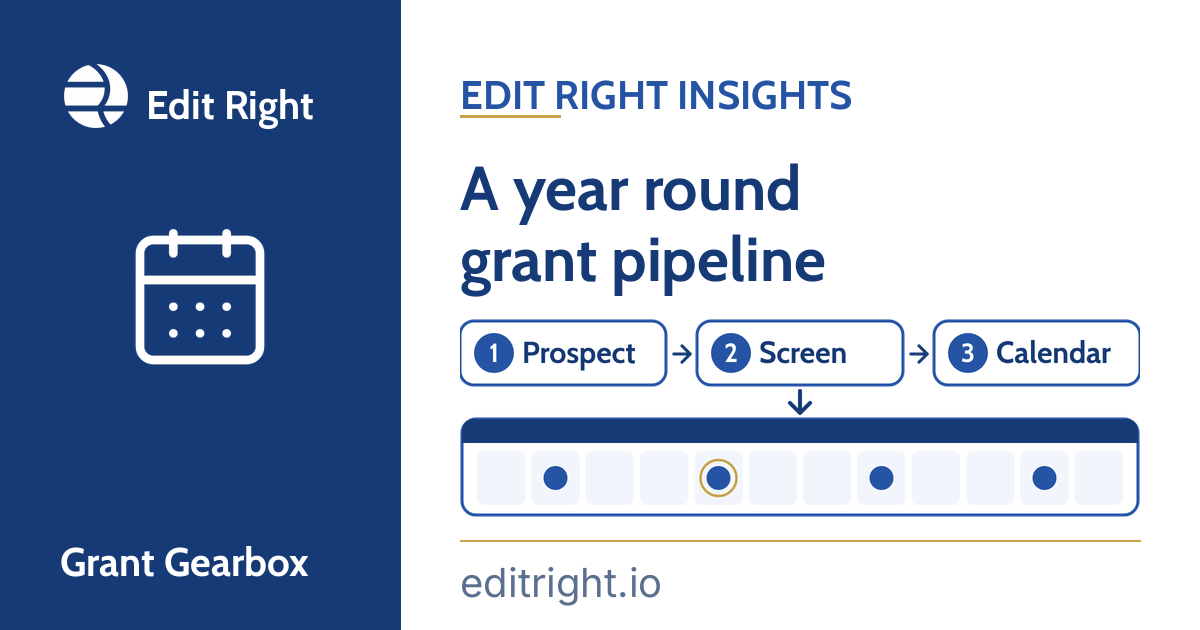
Short answer: A year-round grant pipeline is a short list of funders that fit your work, screened before anyone writes, with every deadline on one shared calendar. Build it in three steps: prospect for funders who back work like yours, screen each one for fit, and work back from every deadline. You get fewer rushed applications and more strong ones.
Too many organizations do not have a grant pipeline. They have an inbox. A call arrives, someone forwards it with "should we go for this?", and two weeks of evenings disappear into an application that was never a good fit. Meanwhile the funder that suits the organization best opens and closes its round without anyone noticing.
A pipeline fixes that by making the decisions earlier, when they are cheap.
Step one: prospect
Start with funders who already back work like yours, not with whatever is open this week. The fastest way to find them is to look at who funds your peers.
- Peer organizations. Read the annual reports and websites of organizations doing similar work in similar places. Funders are often thanked by name.
- Foundation filings. US private foundations file Form 990-PF, which reports their charitable distributions and activities (IRS). Public copies show who a foundation has supported and at what scale.
- Federal listings. Grants.gov lets you search opportunities by status, including forecasted ones that have not opened yet (Grants.gov). A forecast is an early warning worth having.
- Funder newsletters. Sign up for the ones that matter. They often announce rounds before the formal call.
Record each prospect in one place. A spreadsheet is enough. What matters is that everyone looks at the same list.
Step two: screen for fit before you write a word
A prospect is not an opportunity until it passes a basic screen. Check four things:
- Mission. Does the funder's stated priority match a program you already run or plan to run, without bending it out of shape?
- Location. Does it fund where you work?
- Grant size. Is the typical award in a range your organization can absorb and manage?
- Eligibility. Legal status, registration, audit history, match requirements, and any rule that excludes you outright.
Add a fifth question that teams often skip: can we deliver this if we win? A perfect fit on paper that would stretch your staff past breaking point is not a fit.
Each prospect then gets one of three labels: pursue, watch, or drop. Dropping is a good outcome. It frees time for the applications that deserve it. For a fuller version of this test, see our guide to the bid or no bid decision.
Step three: put every deadline on one shared calendar
Every prospect marked pursue goes onto a single calendar that leadership, program staff, and finance can all see. Not in one person's head, and not in a personal inbox.
Then work back from each deadline. The submission date is the last date, not the planning date. For each one, set:
- A go or no go date, when you confirm you are applying
- A start date for the outline, built from the funder's criteria
- A first draft date
- An internal review date, with a reviewer who did not write it
- A final date a few days before the deadline, to leave room for upload problems
Federal funders give you a structural advantage here. Under the Uniform Guidance, federal agencies should keep funding opportunities open for at least 60 calendar days. They may use a shorter window, but should not go below 30 calendar days unless urgent circumstances justify it (2 CFR 200.204). If the call is in your pipeline before it opens, those days are yours. If you find it three weeks before closing, most of them are already gone.
A worked example
The following is an invented example for illustration, not a real client. A small environmental education nonprofit applies to whatever crosses its desk and usually submits on the last day. After one month of prospecting, its pipeline looks like this:
| Funder type | Fit | Usual round | Decision | Owner |
|---|---|---|---|---|
| Regional family foundation | Strong: funds youth outdoor learning locally | Opens February | Pursue | Executive director |
| State agency program | Good, but needs a cost match | Forecast for spring | Watch until match confirmed | Finance lead |
| National corporate fund | Weak: funds only urban schools | Rolling | Drop | None |
| Community foundation | Strong: past grants to peer groups | Opens September | Pursue | Program manager |
Two pursue decisions, one watch, one drop. The calendar now shows the February round, so the outline starts in December and the draft is reviewed in January. The September round goes on the calendar too, with its own backward plan. For the first time the team knows in November what it will be writing in February.
Nothing about the organization's capacity changed. It stopped spending that capacity on applications it could not win.
Keep the pipeline alive
A pipeline is not a one time exercise. Two habits keep it useful:
- A short monthly review. Twenty minutes to update statuses, add new prospects, and move dates. Treat it as a standing meeting, not an extra.
- A record after every decision. When an application is won, lost, or dropped, note why. Funder feedback, even a short decline letter, tells you how to screen next time.
How Edit Right helps
Our Grant Writing and Resource Mobilization service includes prospect research and funding strategy, so the pipeline and the proposals come from the same plan. Grant Gauge, our bid or no bid model, gives each opportunity a recorded go, go with conditions, or no go before anyone writes.
Frequently asked questions
How many funders should be in the pipeline?
Enough that you are never forced to apply for a poor fit, and few enough that your team can manage them. For many small organizations that means a short list of strong prospects, reviewed monthly, rather than a long list nobody updates.
What if a great opportunity appears with a short deadline?
Run the same screen, faster. If it passes and you can deliver a strong application in the time left, go. If not, put the funder on the calendar for its next round. Many funders run again.
Do we need special software?
No. A shared spreadsheet and a shared calendar are enough to start. Software helps once the list grows, but the discipline matters more than the tool.
Sources
- Internal Revenue Service, About Form 990-PF, Return of Private Foundation. https://www.irs.gov/forms-pubs/about-form-990-pf (accessed November 13, 2026).
- Grants.gov, Search Grants. https://www.grants.gov/search-grants (accessed November 13, 2026).
- Electronic Code of Federal Regulations, 2 CFR 200.204, Notices of funding opportunities. https://www.ecfr.gov/current/title-2/subtitle-A/chapter-II/part-200/subpart-C/section-200.204 (accessed November 13, 2026).
Talk it through
Want help building a grant pipeline your team can keep running?
Book a free call: editright.io/call
Newsletter
Get the Latest Updates
Funding opportunities, proposal and grant writing tips, and practical insights straight to your inbox.