
 Edit Right Advisors
Outputs vs outcomes: how to write results funders believe
6 min read
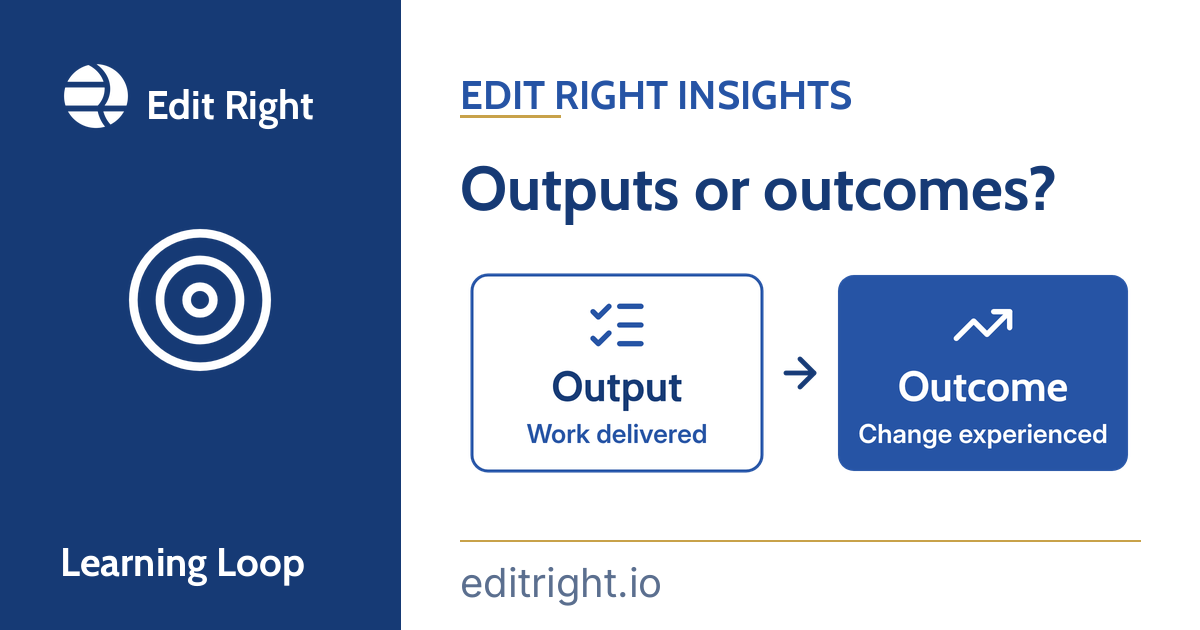
Short answer: An output is the work your program delivers, such as trainings held or kits distributed. An outcome is the change people experience because of that work, such as teachers using new methods in class. Funders usually care more about outcomes than about activity counts. Write each one as who changes, what changes, by how much, and by when, then say how you will know it happened.
Read the results section of a typical proposal and count the verbs. Train, deliver, distribute, conduct, hold, reach. Every one of them describes something the organization does. None of them describes what is different for anyone afterward. It is a common weakness in results writing, and reviewers spot it within a paragraph.
The difference in plain terms
The W.K. Kellogg Foundation's Logic Model Development Guide is still one of the clearest references on this. It defines outputs as the direct products of program activities, and outcomes as specific changes in participants' behavior, knowledge, skills, status, and level of functioning (Kellogg Foundation, 2004).
Put more bluntly: you control your outputs. You only influence your outcomes. That is why funders care more about the second. Anyone can promise to run 20 workshops. The question a reviewer is asking is what will be true for the people in those workshops a year later.
| Aspect | Output | Outcome |
|---|---|---|
| What it describes | Work delivered | Change experienced |
| Who controls it | Your team | Your team influences it |
| Typical verbs | Train, deliver, distribute, hold | Use, adopt, increase, reduce, keep |
| Example | 40 teachers complete a training course | Teachers use new reading methods in class |
| How you check it | Attendance records, delivery logs | Classroom observation, follow-up surveys |
Why proposals drift into outputs
Outputs are comfortable. They are countable, they happen inside the grant period, and the team can promise them without risk. Outcomes require a claim about other people's behavior, which feels exposed.
There is also a vocabulary problem. Funders do not all use the terms the same way. US federal rules, for example, ask agencies to communicate "expected outcomes (such as outputs, service performance, or public impacts of any of these)" along with indicators, targets, and baseline data (2 CFR 200.301). Other funders say results, objectives, or impact for the same idea. Use the funder's label in your headings. Keep the distinction underneath it, because the logic still has to show how delivered work leads to change.
Write outcomes in four parts
A strong outcome statement answers four questions in one sentence:
- Who changes? Name the group, as specifically as the program allows.
- What changes? A behavior, a skill, a condition, or a practice, not a feeling.
- By how much? A target, even a modest one.
- By when? A date or a point in the program.
"Improve teaching quality" answers none of them. "By the end of the second school year, at least half of participating teachers use guided reading in a weekly lesson" answers all four. It is less impressive on first reading. It is far more believable, and a reviewer can score it.
Then add the fifth piece, which is where most proposals stop short: how you will know. Name the indicator, the data source, and when you will collect it. If the honest answer is that you have no way to observe the change, the outcome is either wrong or needs a different measure.
A worked example
The following is an invented example for illustration, not a real client. A teacher training program writes its first results section like this:
- Deliver a five-day reading methods course to 40 primary teachers
- Provide each school with a set of graded readers
- Hold monthly coaching visits
All three are outputs. Here is the rewrite, keeping the same activities but adding the change they are meant to cause:
| Level | Statement | How we will know |
|---|---|---|
| Output | 40 primary teachers complete the reading methods course by March | Attendance records |
| Short-term outcome | By June, at least three quarters of trained teachers can plan a guided reading lesson unaided | Lesson plan review at coaching visits |
| Intermediate outcome | By the end of the school year, at least half use guided reading weekly | Classroom observation with a simple checklist, baseline in term one |
| Longer-term outcome | Pupils in those classrooms show measurable gains in fluency against their baseline | Short reading assessment, start and end of year |
Notice what happened. The outputs did not disappear. They became the first rung of a ladder, and each rung above names a change and a way to see it. The reviewer can now follow the logic from the course to the classroom to the pupil.
Notice also what the rewrite does not claim. It does not promise a jump in national literacy rates. A single program can rarely prove that, and reviewers discount it when they see it.
Traps to avoid
Awareness as an outcome. "Increased awareness" is rarely enough on its own. Ask what people will do differently once they are aware, and write that.
Outcomes nobody can measure in time. If the change takes five years and the grant lasts two, say so. Set a nearer outcome you can observe, and explain how it links to the longer one.
Targets pulled from nowhere. A target with no baseline is a guess. If you have no baseline, plan to collect one in the first months and set the target once you have it, telling the funder that is the plan.
Indicators that measure the output again. "Number of teachers trained" is not an outcome indicator, however it is labeled.
Where this fits
Clear outcomes are the backbone of a monitoring, evaluation, and learning (MEL) plan and of every report that follows. Our Monitoring, Evaluation, and Learning service and its MEL Map model start from the outcome statements and work out what to measure. When it is time to report, our Research and Reporting service checks that the results claimed match the evidence held. For the wider plan, see our guide on how to write a MEL plan that works in practice.
Frequently asked questions
Is impact the same as an outcome?
Impact usually means the long-term, wider change a program contributes to, such as better community health or higher household income. Outcomes are the nearer changes your program can show evidence for. Most proposals should promise outcomes and explain how they contribute to impact.
Can a funder ask for outputs only?
Some do, especially for small or short grants. Report what they ask for. It still helps to track one or two outcomes internally, because they make the next proposal stronger.
How many outcomes should a proposal have?
Fewer than most teams write. A handful of well-measured outcomes is more convincing than a long list nobody can track. Check the funder's template first, as some set the number.
Sources
- W.K. Kellogg Foundation, Logic Model Development Guide, updated January 2004. https://wkkf.issuelab.org/resource/logic-model-development-guide.html (accessed November 13, 2026).
- Electronic Code of Federal Regulations, 2 CFR 200.301, Performance measurement. https://www.ecfr.gov/current/title-2/subtitle-A/chapter-II/part-200/subpart-D/section-200.301 (accessed November 13, 2026).
Talk it through
Want results that read as real change in your next proposal?
Book a free call: editright.io/call
Newsletter
Get the Latest Updates
Funding opportunities, proposal and grant writing tips, and practical insights straight to your inbox.