
 Edit Right Advisors
Funder reports that pass the first time: a five-level quality check
5 min read
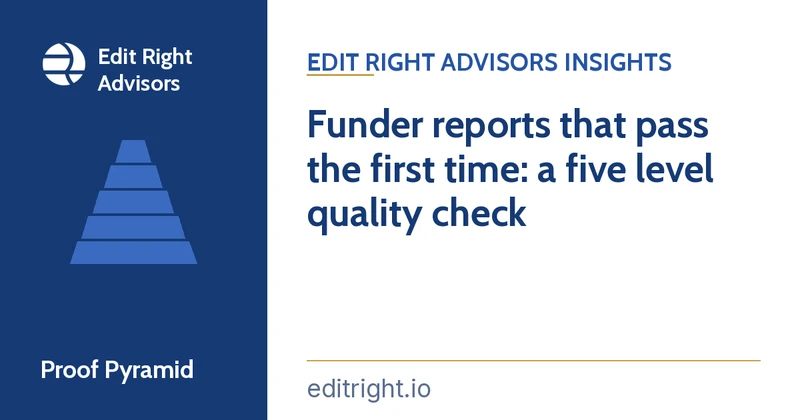
A funder report passes review when it follows the funder’s rules, every figure traces to a source, and the narrative, results, and finances tell one story. It also explains results and variances honestly and gives the funder clear next steps. Checking a report at these five levels before it goes out prevents most queries and delays.
Many nonprofits have had a report sent back even though it was well written. A figure did not reconcile, the narrative contradicted the budget, or a required annex was missing. Each query slows approval, and repeated queries erode the trust that renewals depend on.
What funders look for in a report
Funders differ, but their core expectations repeat. US federal rules give a clear example. When reporting program performance, a recipient must relate financial data and program accomplishments to the performance goals and objectives of the award (2 CFR 200.329).
The same section says performance reports should, as applicable, include:
- A comparison of accomplishments with the objectives set for the reporting period
- Explanations of why established goals or objectives were not met
- Additional analysis and explanation of cost overruns or higher-than-expected unit costs
It also sets timing. Annual reports are due no later than 90 calendar days after the reporting period, and quarterly or semiannual reports no later than 30 days after. The final performance report is due no later than 120 days after the period of performance ends. Your own award terms govern, so check them first.
In short, funders want to see what you planned, what happened, why any gap arose, and how the money and the results connect.
The five levels of a quality report
At Edit Right Advisors, we check reports with Proof Pyramid, the report and proposal quality model in our Evidence Engine framework. A reviewer who did not write the draft checks it at five levels, from the base up. Each level rests on the one below it.
Level 1: Compliant
Does the report use the right template, sections, and annexes, and does it meet the deadline and every rule? Compliance comes first because a report that misses a required section can be returned before anyone reads its findings.
Level 2: Accurate
Does every number, name, and claim trace to a named source and reconcile? Totals should match across tables, the narrative, and annexes. Figures should match the source records behind them.
Level 3: Aligned
Do the narrative, the results framework, and the budget or financial report tell one story? If the narrative says an activity expanded, the spending should show it. If spending fell short, the narrative should explain why.
Level 4: Insightful
Does the report explain results, variances, and lessons honestly? A list of activities is not insight. Say what worked, what did not, and what you learned, including results that fell short.
Level 5: Useful
Does the report give the funder and the team clear asks, next steps, and decisions? A useful report ends with what happens next, such as a proposed adjustment, a request for a budget realignment, or a plan to address a shortfall.
Only a report that passes all five levels goes for sign-off. The output is either a clear pass or a prioritized fix list.
Why honest reporting builds trust
Reporting a shortfall can feel risky. In practice, funders read many reports, and they tend to trust the ones that show their evidence and explain their gaps. The federal rule above asks for exactly that: explanations of why goals were not met.
Good evidence practice supports the same approach. The Bond Evidence Principles, designed for NGOs to assess the quality of evidence, can be used to review evaluation and research reports before they are signed off (Bond). Proof Pyramid draws on the Bond Evidence Principles. Its five principles are voice and inclusion, appropriateness, triangulation, contribution, and transparency. Two of them map directly onto a report check: transparency about methods and limits, and honesty about the program’s contribution to change.
How to prepare a report that passes
The reporting track in Evidence Engine runs four steps before the quality check:
- Map: list every reporting requirement and deadline in the grant agreement.
- Compile: bring together program data and monitoring, evaluation, and learning (MEL) data, and set results against the results framework.
- Align: make the narrative, the results framework, and the financial report tell one story.
- Assure: check the report at the five levels before sign-off.
Start the map at the beginning of the award, not the week before the deadline. Alignment problems are cheaper to prevent during the reporting period than to fix at the end of it.
Common reasons reports are sent back
The same problems appear often:
- Totals that differ between the narrative and the tables
- Activities reported with no link to the results framework
- Spending variances left unexplained
- Shortfalls reported without a reason or a plan
- A missing annex, signature, or required section
Each one is preventable with a structured check before submission.
Frequently asked questions
Why does compliance come first?
A report that misses a required section or deadline can be returned before anyone reads its findings. Compliance is the base everything else rests on.
Do you check our financial reports?
We check that the narrative and the financial report tell one story and that variances are explained. We do not provide legal, audit, or financial compliance services or certify financial reports.
Can you write our report from data we have already collected?
Yes. We compile and check the data, align it with the results framework and the financial report, and prepare the report for your sign-off.
Talk it through
Proof Pyramid is part of SS-04 Research and Reporting, delivered through Evidence Engine. Have a report deadline coming up? Book a free call. We will look at what the funder requires and tell you what it will take to get there. You can also reach us at hello@editright.io or +1 314 998 0221.
Sources
- 2 CFR 200.329, Monitoring and reporting program performance (eCFR). Accessed October 27, 2026.
- Bond, Evidence Principles. Accessed October 27, 2026.
Newsletter
Get the Latest Updates
Funding opportunities, proposal and grant writing tips, and practical insights straight to your inbox.