
 Edit Right Advisors
Model 4A of Evidence Engine. Report it right.
Assessment Arc
Assessment Arc is Edit Right Advisors' assessment design model. It starts from the decision the evidence must inform, then selects the right type of assessment: situation analysis, needs assessment, baseline study, gap analysis, GEDSI assessment, or stakeholder mapping. The design is agreed in an inception report, and every assessment ends in findings and recommendations decision makers can use.
What is Assessment Arc?
Assessment Arc is Edit Right Advisors’ assessment design model. An assessment that is too thin cannot support a decision, and one that is too heavy wastes time and budget. Many studies start with a method rather than a question, so the findings arrive without a clear use. Assessment Arc matches the assessment to the decision, so the study answers what leaders and funders need to know.
When should you use Assessment Arc?
Use it if a proposal or program needs evidence and you are not sure which kind of assessment will answer the question.
In your words: “We need a needs assessment for the proposal, but we are not sure what kind.”
How does Assessment Arc work?
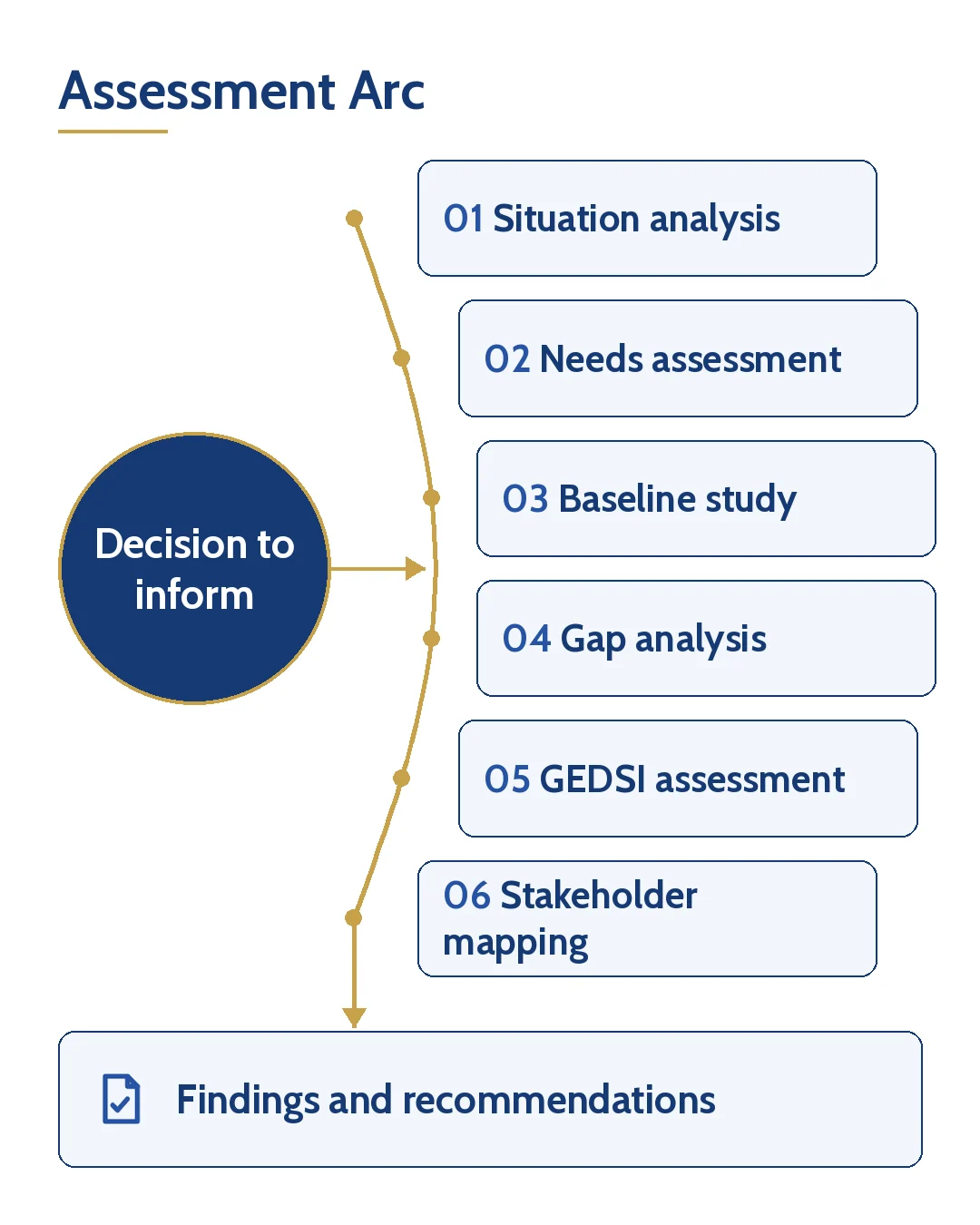
The arc begins with the decision to inform, sweeps across six assessment types, and lands on findings and recommendations. The questions, tools, and sampling approach are agreed in an inception report before data collection begins.
- Decision to inform (start): The decision the evidence must support, and who will make it.
- Situation analysis (01): To understand the wider context before designing or adapting a program.
- Needs assessment (02): To identify and prioritize the needs of a population or group.
- Baseline study (03): To measure starting values for the indicators a program will track.
- Gap analysis (04): To compare the current situation with a desired standard or result.
- GEDSI assessment (05): To examine gender equality, disability, and social inclusion in a context or program.
- Stakeholder mapping (06): To identify the people and institutions that shape or are affected by the work.
- Findings and recommendations (end): Clear findings and practical recommendations for the decision.
What you get
- Outputs: an inception report with a research matrix, tools, and a sampling approach, followed by an assessment report with findings and recommendations.
- Result: decisions rest on evidence sized to the question, and the study delivers findings people use.
Delivered through SS-04 Research and Reporting.
What we need from you
- The decision the evidence must inform, and who will make it
- The context, existing evidence, and any terms of reference
Who it is for
- NGOs and community-based and similar organizations: choose the right assessment for the decision in front of them.
- Funders: receive baselines, needs assessments, and context analysis that support proposals.
- Government: receive situation and needs evidence for planning.
- Researchers: get assessments with a clear design and a defined decision to inform.
Illustrative example
Illustrative example only. This is a generic scenario, not a client result.
An organization preparing a proposal is asked for evidence of need in a new area. Assessment Arc starts by naming the decision: whether and how to design the program there. A needs assessment fits that decision better than a full situation analysis. The questions, tools, and sampling approach are agreed in an inception report, and the final report gives findings and practical recommendations for the proposal.
Recognized practice behind Assessment Arc
- Standard assessment types. The six types are standard assessment terms in international development and humanitarian practice.
- Utility. Starting from the decision to inform reflects the utility norm in the UNEG Norms and Standards for Evaluation.
Sources: UNEG Norms and Standards for Evaluation; OECD evaluation criteria.
Edit Right models are our own structured adaptations of established practice. Naming a benchmark, author, or institution does not imply accreditation, membership, or endorsement.
How Assessment Arc connects
4B Inclusion Insight Lens
Explore the model4C Proof Pyramid
Explore the model3A MEL Map
Explore the modelParent framework: Evidence Engine
Back to the frameworkFrequently asked questions
Which assessment types does Assessment Arc cover?
Situation analysis, needs assessment, baseline study, gap analysis, GEDSI assessment, and stakeholder mapping.
What is an inception report?
It is the document that sets out the agreed design before data collection begins, including a research matrix, tools, and a sampling approach.
What is the difference between a needs assessment and a baseline study?
A needs assessment identifies and prioritizes what a group needs. A baseline study measures where a program’s indicators stand before the program begins.
Key terms
- Situation analysis: A study of the wider context before designing or adapting a program.
- Gap analysis: A comparison of the current situation with a desired standard or result.
- Research matrix: A table linking each assessment question to its data sources and methods.
- Stakeholder mapping: Identifying the people and institutions that shape or are affected by the work.
Not sure Assessment Arc is the right place to start? Book a free call: editright.io/call We will listen, tell you honestly whether it fits, and suggest a first step.
Email hello@editright.io or call +1 314 998 0221.
Newsletter
Stay in touch
Choose the topics you want, and we will send them to your inbox.