
 Edit Right Advisors
Templates
Edit Right Advisors templates are free tools that nonprofit and NGO teams can adapt for their own work, such as a bid decision checklist, a proposal compliance matrix, or a MEL plan outline. Each template comes with short instructions and links to the guide or service it supports.
Free templates
R01 · 5 pages
Bid or No Bid Funding Opportunity Checklist
Decide in one meeting whether a funding call is worth pursuing. First, check five must-pass gates. Then score eight criteria, convert the total to a percentage, and leave with a clear Go, Go with conditions, or No go and a named owner.
See the model
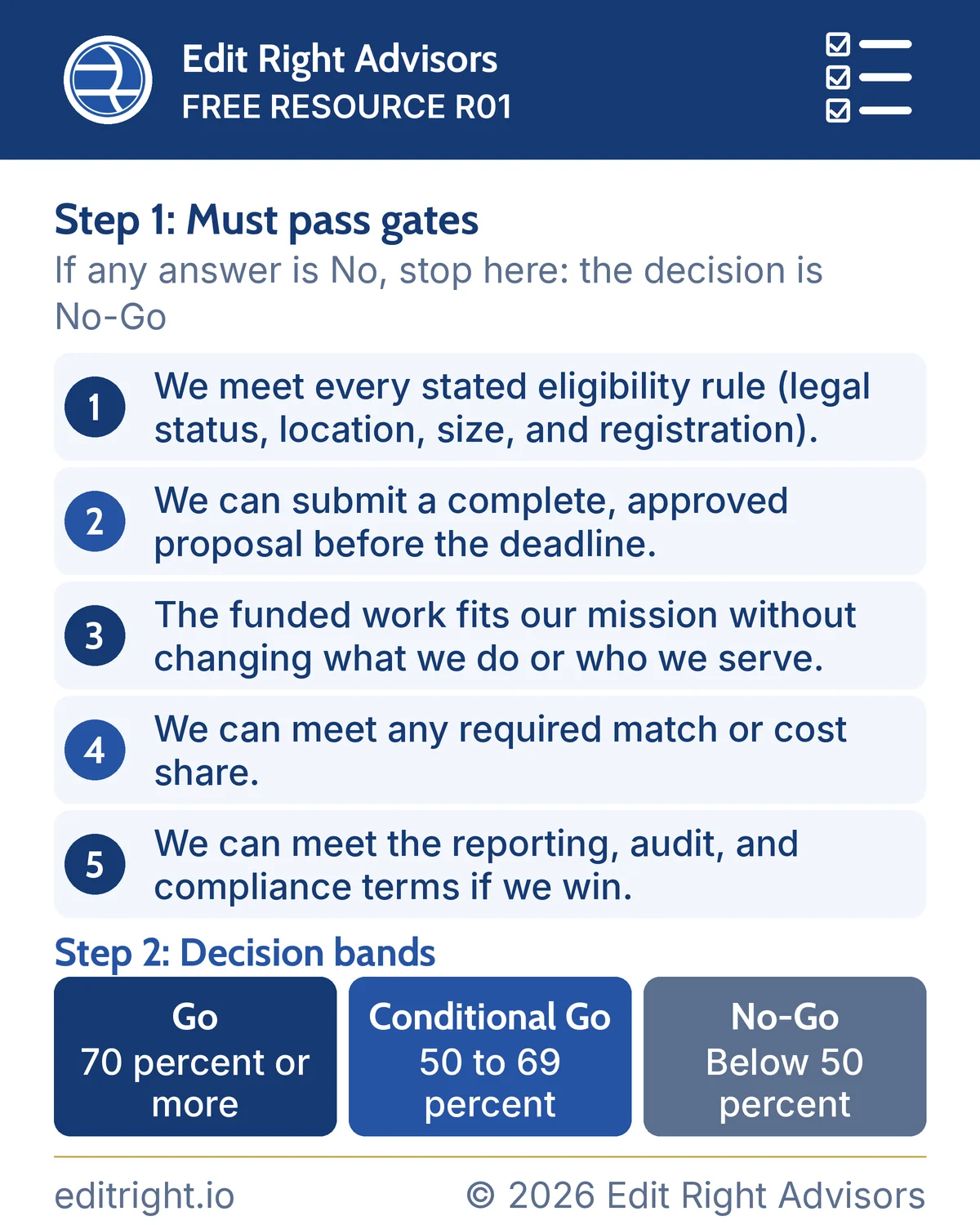
Five must-pass gates, 8 criteria scored 0 to 3 with optional weights, percentage decision bands, minimum scores, a short explanation of the bands, a decision record, and a worked example. Design: Edit Right Advisors, 2026. 
R02 · 5 pages
Pre-Proposal Planning Worksheet
Before anyone starts drafting, answer the eight questions every strong proposal rests on. Each answer is linked to the proposal section it feeds. You mark what you can prove and what is still an assumption.
See the model

The eight planning questions. Each shows the proposal section it feeds and has a status line; there is also a readiness rule and a worked example. Design: Edit Right Advisors, 2026. The eight questions are credited to Atiq Rehman. 
R03 · 5 pages
Logic Model and Theory of Change Template
Map your program from inputs to impact on one page, using the standard results-chain terms. Then explain why each step should lead to the next, and list the risks and external factors that could get in the way.
See the model
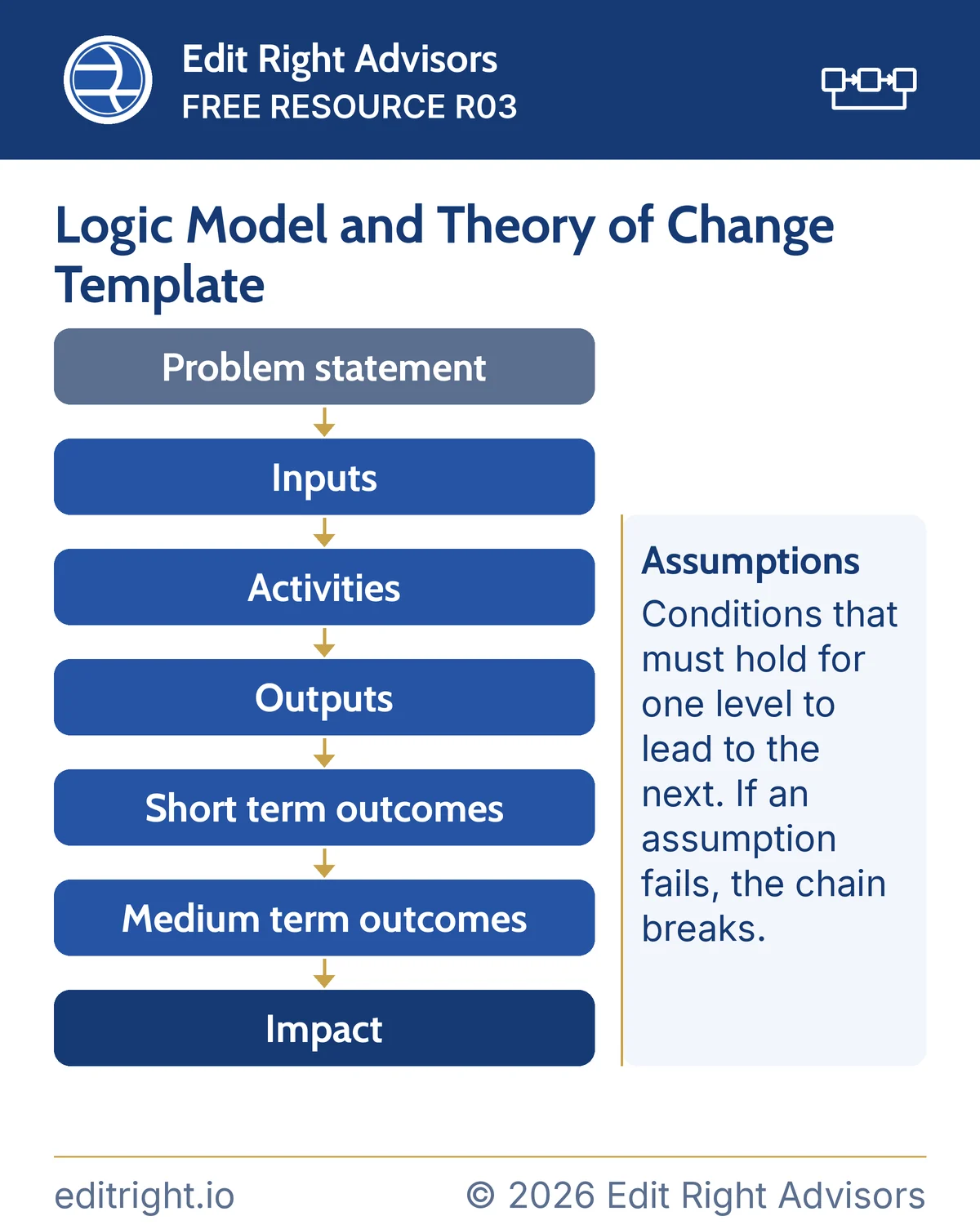
Definitions in plain words, a landscape logic model, a theory of change statement, external factors, a risk table (likelihood and impact), a quality check, and a worked example. Design: Edit Right Advisors, 2026. Results chain terms follow the W.K. Kellogg Foundation Logic Model Development Guide (2004) and the OECD Glossary (2023). 
R04 · 6 pages
Proposal-Stage MEL Starter Template
Build a short, credible indicator table with baselines, targets, and means of verification. Add a reference sheet for your key indicators, then cost your monitoring, evaluation, and learning work before the budget is final.
See the model

Column guide, a landscape 10-column indicator table, an indicator reference sheet, learning questions, MEL budget lines, and a worked example. Design: Edit Right Advisors, 2026. 
R05 · 5 pages
Proposal Budget Alignment Checklist
Make sure your budget and narrative tell the same story, and that every cost meets your funder's rules. Includes examples from US, EU, and UK funding rules.
See the model

A seven-part checklist for any funder. It cites US, EU, and UK FCDO cost rules as examples. Worked example included. Design: Edit Right Advisors, 2026.
Ready to talk about your next proposal, plan, or report?
Book a free call: editright.io/call We will tell you honestly whether we fit, and suggest a first step even if it is not with us.
Response times: we reply to general inquiries within two business days, and to detailed or technical inquiries within five business days.
Newsletter
Get the Latest Updates
Funding opportunities, proposal and grant writing tips, and practical insights straight to your inbox.