
 Edit Right Advisors
Model 1B of Strategy Studio. Plan it right.
Priority Prism
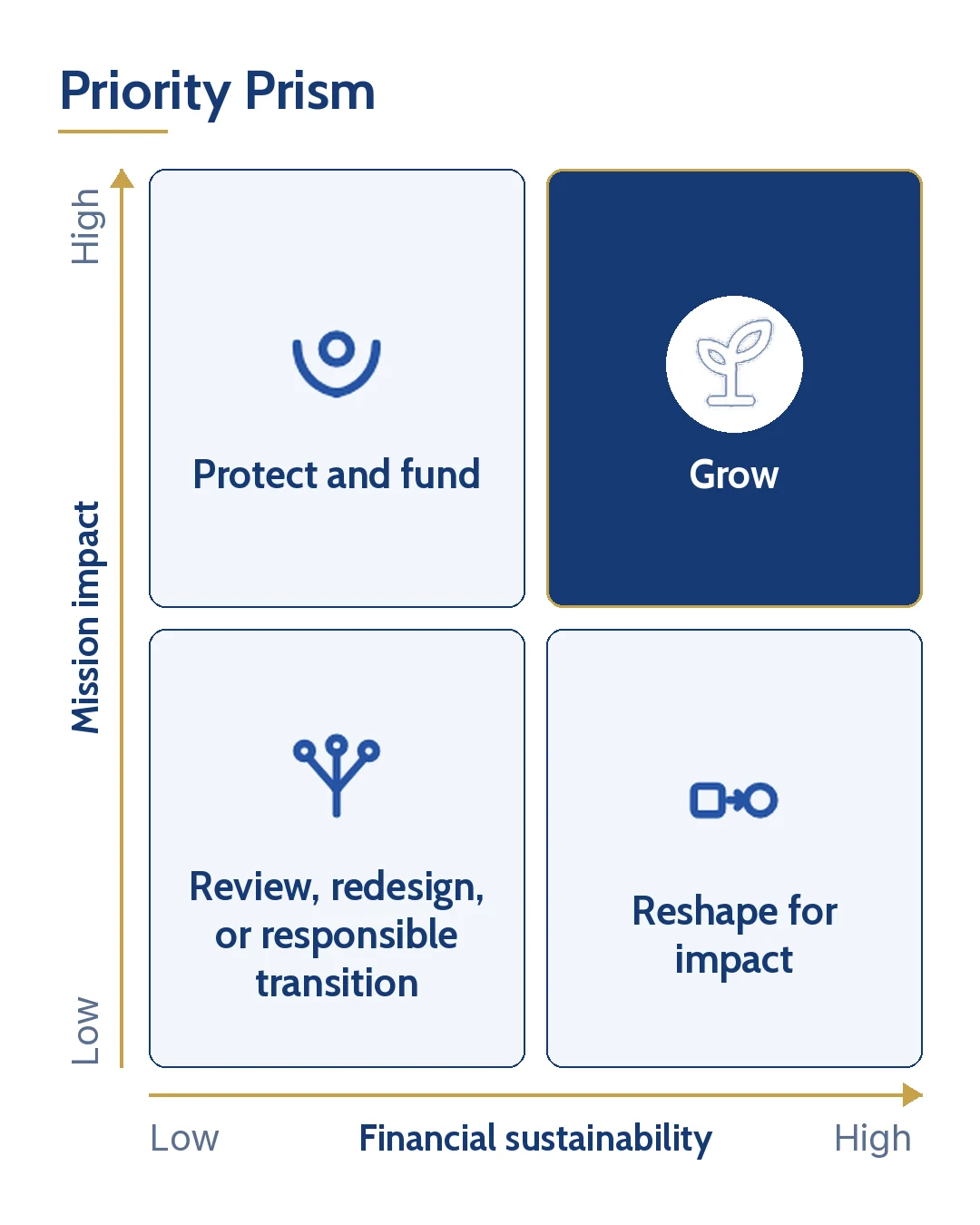
Priority Prism is Edit Right Advisors' portfolio prioritization matrix. It places each of your programs on two measures, mission impact and financial sustainability, to guide one of four choices: grow, protect and fund, reshape for impact, or review, redesign, or responsible transition. The matrix frames the discussion; your leaders make the decision.
What is Priority Prism?
Priority Prism is Edit Right Advisors’ portfolio prioritization matrix. Most organizations add programs over time and rarely stop any. Left unsolved, resources spread thin, strong programs stall, and hard choices wait until a funding gap forces them. Choosing what to change is hardest for essential services, so Priority Prism gives boards and leaders a shared, transparent way to weigh mission and money together and to plan any change responsibly.
When should you use Priority Prism?
Use it if you run more programs than your funding can sustain and need a fair, transparent way to decide what to grow and what to change.
In your words: “We keep adding programs, and our best ones are underfunded.”
How does Priority Prism work?
The vertical axis is Mission impact, from Low to High. The horizontal axis is Financial sustainability, from Low to High. We agree with you how each measure will be judged, place each program in a quadrant, and then test each placement with leaders and the people affected.
- Grow (high mission impact, high financial sustainability): Invest to expand reach and results.
- Protect and fund (high mission impact, low financial sustainability): Keep the program and build a stronger funding base for it.
- Reshape for impact (low mission impact, high financial sustainability): Redesign so the program contributes more to the mission.
- Review, redesign, or responsible transition (low mission impact, low financial sustainability): Examine the program closely, then redesign it or plan a responsible transition.
What you get
- Outputs: a portfolio review with a clear decision and rationale for each program.
- Result: resources move toward the programs that best serve the mission, and any transition is planned with care for the people affected.
Delivered through SS-01 Strategic Advisory and Program Design.
What we need from you
- Your current program portfolio
- What each program achieves and what it costs
- The views of leaders and, where possible, the people each program serves
Who it is for
- NGOs and community-based and similar organizations: decide which programs to grow, protect, reshape, or transition.
- Funders: see funds directed to programs with clear mission impact.
- Government: see choices weighed openly by mission impact and financial sustainability.
- Researchers: get a clear record of how portfolio choices were made.
Illustrative example
Illustrative example only. This is a generic scenario, not a client result.
A community organization runs six programs, and two of its strongest are underfunded. Leaders agree how mission impact and financial sustainability will be judged, then place each program in a quadrant. One program lands in protect and fund, so the team builds a stronger funding base for it. Another lands in review, redesign, or responsible transition, and the board plans how to support the people it serves before any change.
Recognized practice behind Priority Prism
- Portfolio prioritization. Priority Prism follows the portfolio matrix tradition in strategic planning, which compares a set of activities on two dimensions.
- Dual bottom line matrix. It aligns with the matrix map in Nonprofit Sustainability (2010) by Jeanne Bell, Jan Masaoka, and Steve Zimmerman, which plots programs by impact and profitability.
- Responsible transition. The label reflects sector practice that ending a service requires planning for the people who rely on it.
Edit Right models are our own structured adaptations of established practice. Naming a benchmark, author, or institution does not imply accreditation, membership, or endorsement.
How Priority Prism connects
1A Readiness Radar
Explore the model1C Change Canvas
Explore the model2A Grant Gauge
Explore the modelParent framework: Strategy Studio
Back to the frameworkFrequently asked questions
What is a dual bottom line matrix?
It is a tool that plots programs by mission impact and financial sustainability together. Priority Prism aligns with the matrix map in Nonprofit Sustainability (2010) by Jeanne Bell, Jan Masaoka, and Steve Zimmerman.
Who decides how each measure is judged?
You do. We agree the criteria with your leaders before any program is placed, and we test each placement with leaders and the people affected.
Does responsible transition mean closing a program?
Not always. It can mean redesigning a program, finding it a new home, or phasing it out with care for the people who rely on it.
Key terms
- Portfolio prioritization: Comparing a set of programs to decide where to invest time and money.
- Mission impact: How much a program contributes to the organization’s mission.
- Financial sustainability: How well a program’s funding can keep it running.
- Responsible transition: Ending or moving a service with a plan for the people who rely on it.
Not sure Priority Prism is the right place to start? Book a free call: editright.io/call We will listen, tell you honestly whether it fits, and suggest a first step.
Email hello@editright.io or call +1 314 998 0221.
Newsletter
Get the Latest Updates
Funding opportunities, proposal and grant writing tips, and practical insights straight to your inbox.