
 Edit Right Advisors
Model 3A of Learning Loop. Track it right.
MEL Map
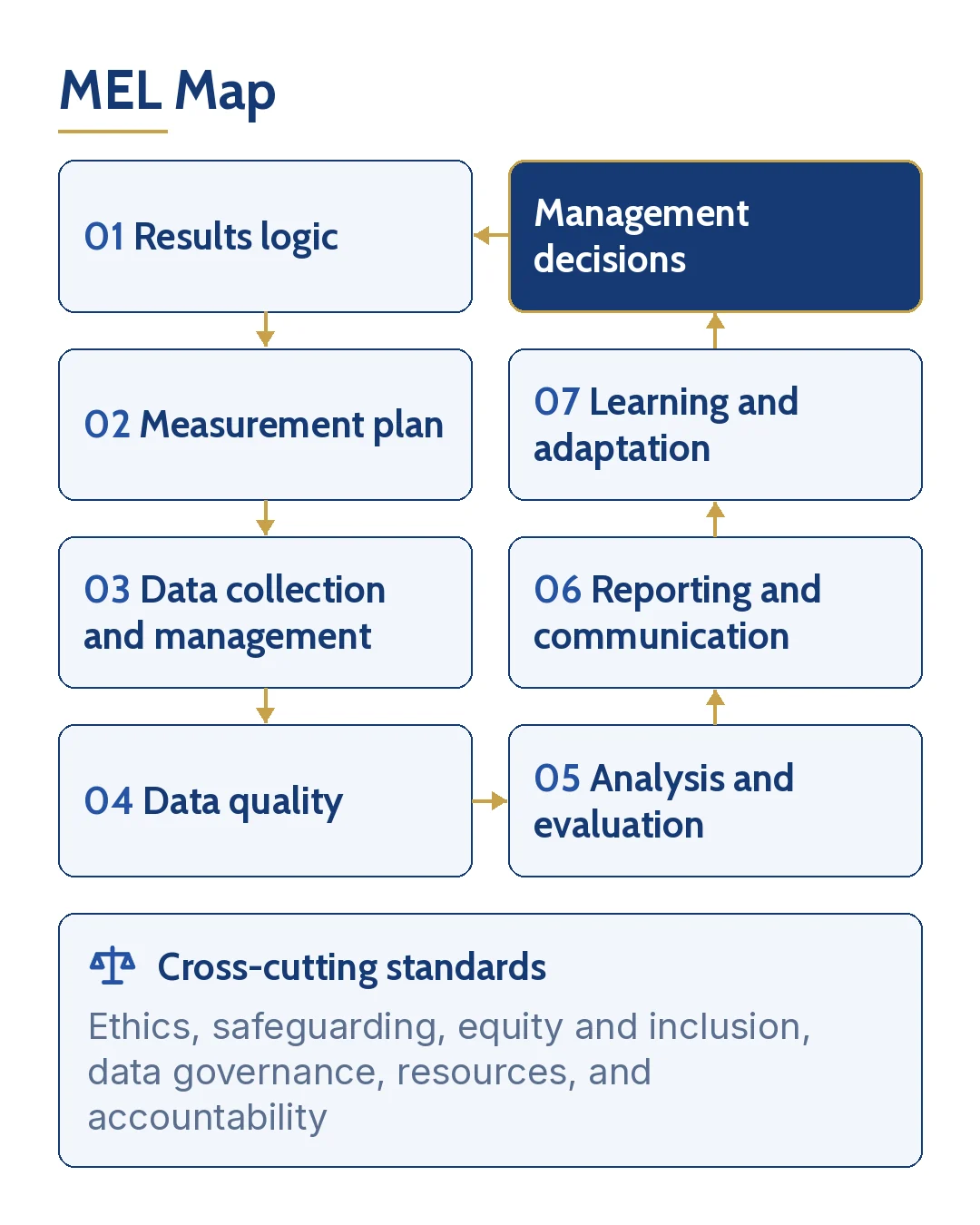
MEL Map is Edit Right Advisors' MEL plan model. It builds a monitoring, evaluation, and learning plan in seven connected parts, from results logic and measurement to data quality, analysis, reporting, and learning, all feeding management decisions. Cross-cutting standards for ethics, safeguarding, equity and inclusion, data governance, resources, and accountability apply to every part.
What is MEL Map?
MEL Map is Edit Right Advisors’ MEL plan model. A MEL plan often grows piece by piece, with indicators in one file, tools in another, and no link to the decisions they should inform. Left unsolved, indicators are measured differently by different staff, baselines are missing when a midterm review arrives, and reports are assembled under pressure. MEL Map gives your program one plan in which every part supports the others.
When should you use MEL Map?
Use it if a funder needs a MEL plan, or your indicators, tools, and reporting calendar sit in separate files that do not connect.
In your words: “Our MEL plan looks complete, but it does not work in practice.”
How does MEL Map work?
The map runs down the left column and up the right column, then returns from management decisions to the results logic. A base of cross-cutting standards supports every part.
- Results logic (01): The theory of change and results framework the plan measures.
- Measurement plan (02): Indicators, with definitions, baselines, targets, and sources.
- Data collection and management (03): Tools, frequency, data flow, and storage.
- Data quality (04): How data will be checked before it is used.
- Analysis and evaluation (05): How data will be analyzed and when evaluations will take place.
- Reporting and communication (06): What is reported, to whom, and when.
- Learning and adaptation (07): How findings will be discussed and used.
- Management decisions (top): The decisions the evidence must inform, which return to 01 Results logic.
Cross-cutting standards: ethics, safeguarding, equity and inclusion, data governance, resources, and accountability.
What you get
- Outputs: a MEL plan and indicator reference sheets your team and your funder can use, mapped to the funder’s template where one applies.
- Result: the program collects the right data, at the right quality, for the decisions that matter.
Delivered through SS-03 Monitoring, Evaluation, and Learning (MEL).
What we need from you
- The program design and its results
- The funder’s MEL requirements and templates
- The people, time, and budget available for MEL
Who it is for
- NGOs and community-based and similar organizations: build a complete MEL plan in seven connected parts.
- Funders: see how results will be measured, checked, and reported.
- Government: see clear indicators, baselines, and targets.
- Researchers: get a documented measurement and evaluation plan.
Illustrative example
Illustrative example only. This is a generic scenario, not a client result.
An NGO wins an award and must submit a MEL plan soon after award. Its indicators sit in one spreadsheet and its tools in another. MEL Map links them in seven parts, starting from the results framework, then adds indicator reference sheets with definitions, baselines, targets, and sources. The plan is mapped to the funder’s template, and each part ties back to the management decisions the evidence must inform.
Recognized practice behind MEL Map
- MEL plan practice. The seven parts reflect the standard sections of a MEL plan required by bilateral and multilateral funders: results framework, indicators, data collection, data quality, evaluation, and reporting.
- Results-based management. 01 Results logic and 02 Measurement plan follow results framework and indicator practice.
- Disaggregation. Equity and inclusion includes data disaggregated by sex, age, disability, and location, in line with the UN Sustainable Development Goals (SDG) global indicator framework.
- Accountability to affected people. The accountability standard reflects the Core Humanitarian Standard on Quality and Accountability (CHS), including its commitments on participation, feedback and complaints, and continuous learning.
- CLA. 07 Learning and adaptation and management decisions reflect the CLA approach to adaptive management. CLA (Collaborating, Learning, and Adapting) is a USAID framework.
Edit Right models are our own structured adaptations of established practice. Naming a benchmark, author, or institution does not imply accreditation, membership, or endorsement.
How MEL Map connects
3B Data Diamond
Explore the model3C Learning Ladder
Explore the model1C Change Canvas
Explore the modelParent framework: Learning Loop
Back to the frameworkFrequently asked questions
What is a MEL plan?
It is a plan that sets out how a program will monitor its results, evaluate its performance, and learn from the evidence. It covers indicators, data collection, data quality, analysis, reporting, and learning.
Can MEL Map follow our funder's template?
Yes. The MEL plan is mapped to the funder’s template where one applies.
What is an indicator reference sheet?
It is a short record for each indicator that sets out its definition, data source, method, frequency, baseline, and target, so everyone measures it the same way.
Key terms
- MEL: Monitoring, evaluation, and learning.
- Results framework: The structured set of results a program commits to and measures.
- Baseline: The value of an indicator before the program begins.
- Disaggregation: Breaking data down by groups such as sex, age, disability, and location.
- CLA: Collaborating, learning, and adapting, an approach to adaptive management.
Not sure MEL Map is the right place to start? Book a free call: editright.io/call We will listen, tell you honestly whether it fits, and suggest a first step.
Email hello@editright.io or call +1 314 998 0221.
Newsletter
Get the Latest Updates
Funding opportunities, proposal and grant writing tips, and practical insights straight to your inbox.