
 Edit Right Advisors
Model 3C of Learning Loop. Track it right.
Learning Ladder
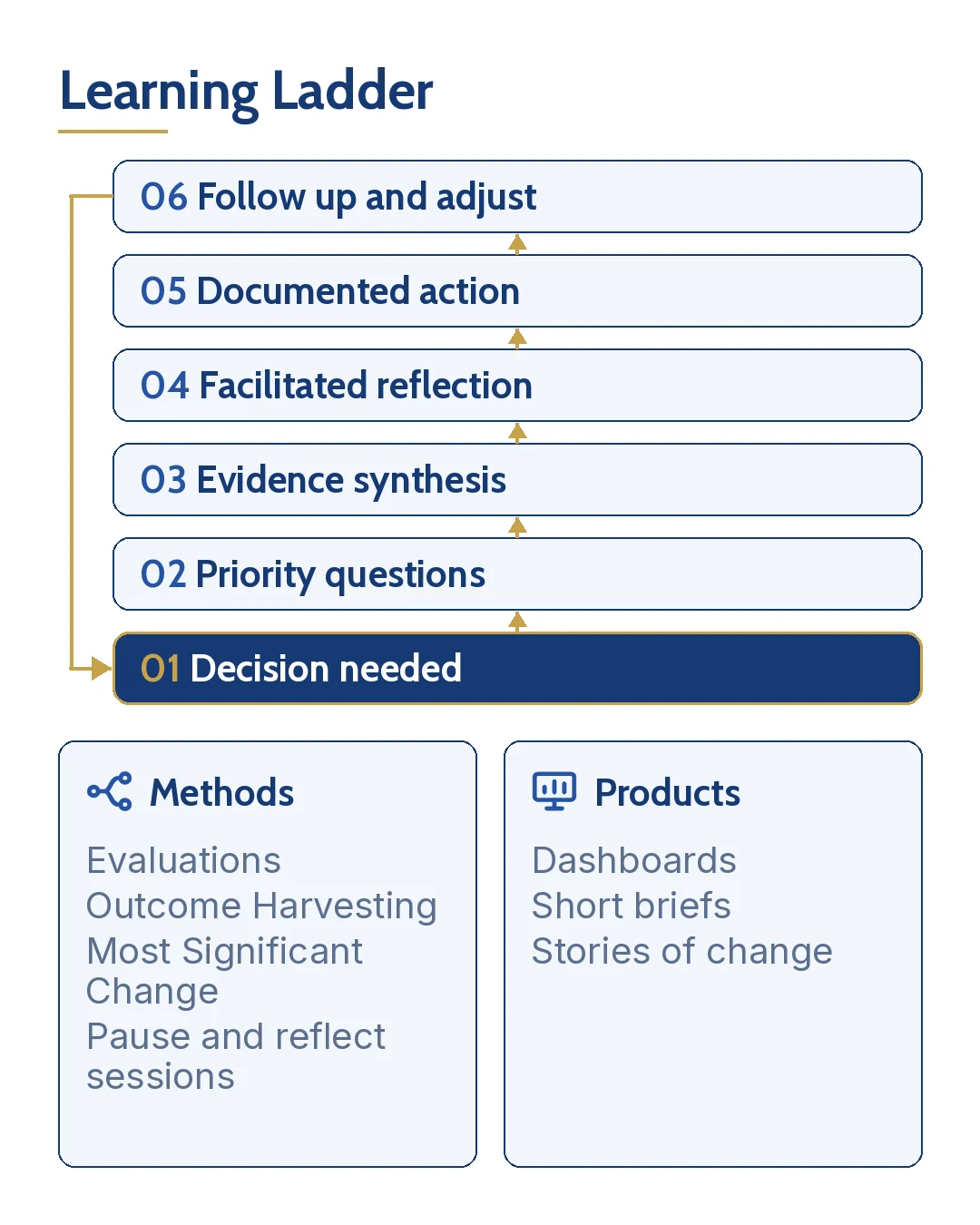
Learning Ladder is Edit Right Advisors' learning agenda model. It starts from the decision you need to make, not the data, then climbs through priority questions, evidence synthesis, facilitated reflection, documented action, and follow up. Evaluations, Outcome Harvesting, Most Significant Change, and pause and reflect sessions supply the evidence, shared through short, usable products.
What is Learning Ladder?
Learning Ladder is Edit Right Advisors’ learning agenda model. Many organizations collect far more data than they use, because no one asked which decisions the data should inform. Left unsolved, evidence arrives too late, mistakes repeat, and funders see no sign that the program adapts. Learning Ladder ties learning to the decisions leaders actually face, so evidence arrives while it can still make a difference.
When should you use Learning Ladder?
Use it if you write lessons learned that never change a decision, or evidence tends to arrive after the decision is made.
In your words: “We write lessons learned, but nothing changes.”
How does Learning Ladder work?
The ladder climbs from 01 Decision needed to 06 Follow up and adjust, then returns to the start for the next decision.
- Decision needed: Name the decision leaders face and when they must make it.
- Priority questions: Turn the decision into a few prioritized learning questions.
- Evidence synthesis: Bring together the evidence that answers each question.
- Facilitated reflection: Discuss the evidence with the people who decide.
- Documented action: Record the decision and the action agreed.
- Follow up and adjust: Check what happened and adjust, then return to 01 Decision needed.
Methods: evaluations, Outcome Harvesting, Most Significant Change, and pause and reflect sessions.
Products: dashboards, short briefs, and stories of change.
What you get
- Outputs: a learning agenda with questions, activities, owners, timing, and use points, plus records of each decision.
- Result: leaders decide on evidence, and the organization keeps what it learns.
Delivered through SS-03 Monitoring, Evaluation, and Learning (MEL).
What we need from you
- The decisions leaders face and when they must make them
- The evidence available, including monitoring data and evaluations
Who it is for
- NGOs and community-based and similar organizations: turn evidence into recorded decisions and action.
- Funders: see how programs learn and adjust.
- Government: see evidence used when decisions are made.
- Researchers: get learning questions linked to documented decisions.
Illustrative example
Illustrative example only. This is a generic scenario, not a client result.
A program’s leaders must decide whether to expand to new districts. Learning Ladder turns that decision into a few priority questions, then brings together monitoring data, a midterm evaluation, and stories of change. A facilitated reflection session with the decision makers discusses the evidence. The agreed action is recorded, and follow up checks what happened before the next decision.
Recognized practice behind Learning Ladder
- Learning agendas. Learning Ladder follows USAID guidance on learning agendas, which ties prioritized learning questions to key decision points.
- CLA. Facilitated reflection and follow up reflect pause and reflect and adaptive management practice in the CLA framework.
- Recognized methods. Outcome Harvesting (Ricardo Wilson-Grau and Heather Britt) and the Most Significant Change technique (Rick Davies and Jess Dart) are established evaluation methods that capture change, including unplanned change, that predefined indicators can miss.
Edit Right models are our own structured adaptations of established practice. Naming a benchmark, author, or institution does not imply accreditation, membership, or endorsement.
How Learning Ladder connects
3A MEL Map
Explore the model3B Data Diamond
Explore the model1C Change Canvas
Explore the modelParent framework: Learning Loop
Back to the frameworkFrequently asked questions
What is a learning agenda?
It is a short set of priority questions tied to upcoming decisions, with the activities, owners, and timing needed to answer them. We facilitate the reflection sessions and record what is agreed.
What methods does Learning Ladder use?
Evaluations, Outcome Harvesting, Most Significant Change, and pause and reflect sessions. These can capture change, including unplanned change, that predefined indicators miss.
What do we receive from each cycle?
Short, usable products such as dashboards, short briefs, and stories of change, plus a record of each decision and the action agreed.
Key terms
- Learning agenda: Priority learning questions tied to key decision points.
- Outcome Harvesting: A method that collects evidence of change and works back to what contributed to it.
- Most Significant Change: A participatory method that collects and discusses stories of change.
- Pause and reflect: A planned session to step back, review evidence, and adjust.
Not sure Learning Ladder is the right place to start? Book a free call: editright.io/call We will listen, tell you honestly whether it fits, and suggest a first step.
Email hello@editright.io or call +1 314 998 0221.
Newsletter
Get the Latest Updates
Funding opportunities, proposal and grant writing tips, and practical insights straight to your inbox.