
 Edit Right Advisors
Model 3B of Learning Loop. Track it right.
Data Diamond
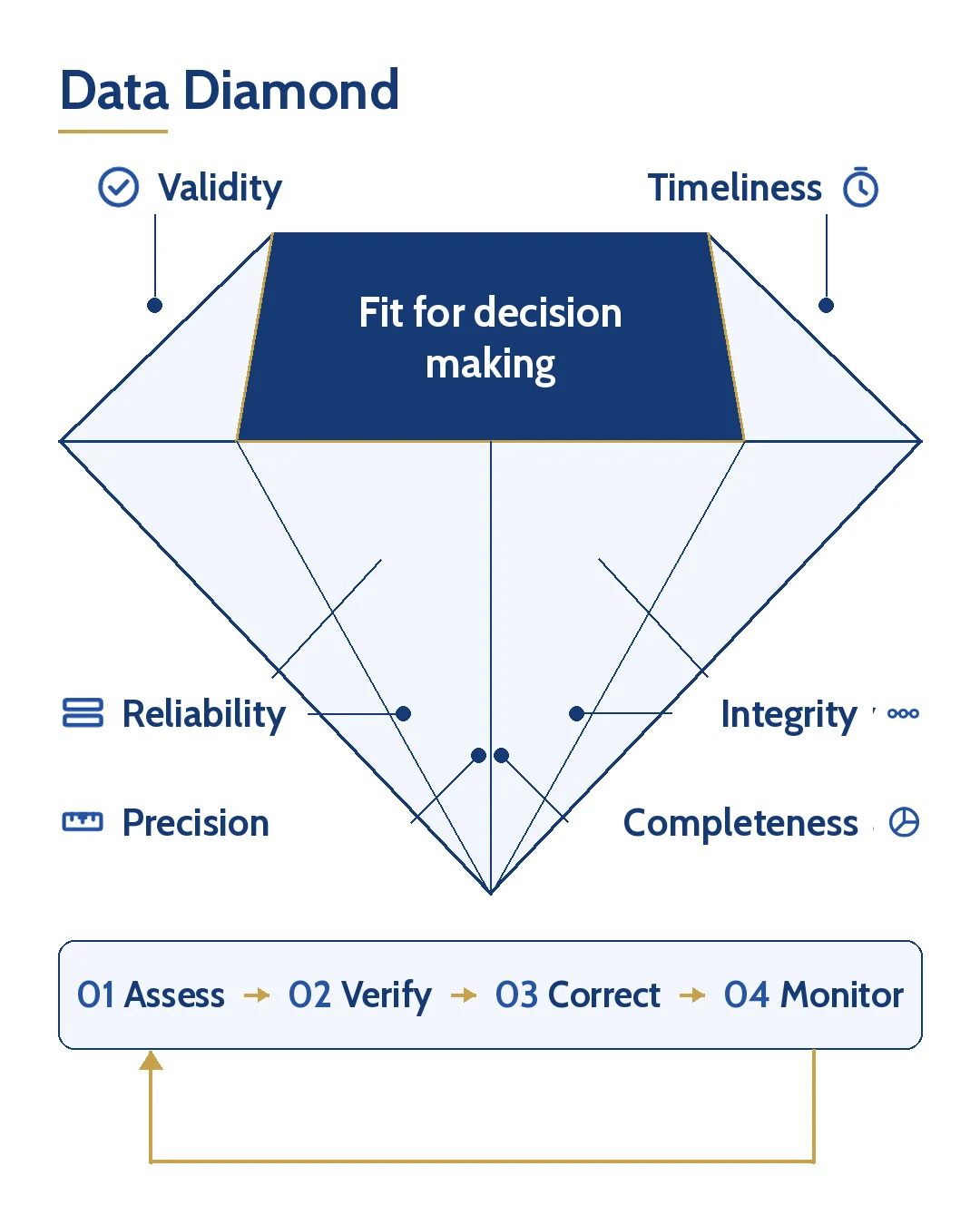
Data Diamond is Edit Right Advisors' data quality model. It checks program data against six quality dimensions: validity, reliability, precision, integrity, completeness, and timeliness. The goal is data fit for decision making. A four-step cycle (assess, verify, correct, and monitor) keeps quality high from one reporting period to the next.
What is Data Diamond?
Data Diamond is Edit Right Advisors’ data quality model. Reports are only as credible as the figures behind them, and funders can check reported figures against source records. Left unsolved, errors surface after a report goes out, which damages trust and can delay funding. Data Diamond finds and fixes problems before a report is due and strengthens the system that produces the data.
When should you use Data Diamond?
Use it if a report or evaluation is coming up and you are not fully confident in the numbers behind it.
In your words: “We are not confident our numbers would survive a donor’s verification visit.”
How does Data Diamond work?
The diamond shows six quality dimensions around one goal at the top: data that is fit for decision making. Below it, a four-step cycle returns to the start each reporting period.
- Validity: Does the data measure what it is meant to measure?
- Reliability: Is the data collected the same way every time?
- Precision: Is the data detailed enough for the decisions it supports?
- Integrity: Is the data protected from deliberate bias or manipulation?
- Completeness: Is all the expected data present?
- Timeliness: Is the data available when it is needed?
- Assess: Select the indicators, sites, and period, and review the data system behind them.
- Verify: Check reported figures against source records.
- Correct: Agree on corrective actions with owners and dates.
- Monitor: Recheck before the next report, then begin the cycle again.
What you get
- Outputs: data quality findings and a corrective action plan with owners and dates.
- Result: managers and funders can trust the reported figures, and the data system improves over time.
Delivered through SS-03 Monitoring, Evaluation, and Learning (MEL).
What we need from you
- The data the program collects and reports
- The source records behind it
- The data system: tools, forms, staff roles, and data flow
Who it is for
- NGOs and community-based and similar organizations: check that their data is fit for decision making.
- Funders: receive figures that trace to source records.
- Government: receive data that meets standard quality dimensions.
- Researchers: get data checked against six quality dimensions.
Illustrative example
Illustrative example only. This is a generic scenario, not a client result.
A program is due to submit an annual report with figures from several field sites. Data Diamond selects the key indicators, sites, and period, then checks reported figures against source records. The check finds, for example, that one site counts repeat visitors twice. The team agrees a corrective action with an owner and a date, then rechecks before the next report.
Recognized practice behind Data Diamond
- Routine data quality assessment (RDQA). The cycle follows the logic of the MEASURE Evaluation RDQA tool, which combines data verification with a system assessment and leads to an action plan. Completeness is a standard dimension in MEASURE Evaluation data quality tools.
- Fit for purpose. The goal reflects the principle, common to these standards, that data quality is judged by the use the data must serve.
Sources: MEASURE Evaluation, Routine Data Quality Assessment tool.
Edit Right models are our own structured adaptations of established practice. Naming a benchmark, author, or institution does not imply accreditation, membership, or endorsement.
How Data Diamond connects
3A MEL Map
Explore the model3C Learning Ladder
Explore the model4C Proof Pyramid
Explore the modelParent framework: Learning Loop
Back to the frameworkFrequently asked questions
What are the six data quality dimensions?
Validity, reliability, precision, integrity, completeness, and timeliness. Together they show whether data is fit for decision making.
What is a routine data quality assessment (RDQA)?
It is a check that combines verifying reported figures against source records with a review of the data system. It leads to an action plan, and Data Diamond follows its logic.
How often should we check data quality?
At least once in each reporting period, and before any major report or evaluation. We agree on the schedule with you.
Key terms
- Data verification: Checking reported figures against the source records behind them.
- Source records: Original documents such as registers and forms that reported figures come from.
- Corrective action plan: Agreed fixes, each with an owner and a date.
- Fit for decision making: Data good enough for the use it must serve.
Not sure Data Diamond is the right place to start? Book a free call: editright.io/call We will listen, tell you honestly whether it fits, and suggest a first step.
Email hello@editright.io or call +1 314 998 0221.
Newsletter
Get the Latest Updates
Funding opportunities, proposal and grant writing tips, and practical insights straight to your inbox.